
You spent years leading teams through high-stakes operations, managing equipment worth millions, and earning certifications that required months of training. Then you submit your resume for a civilian job, and you never hear back.
The problem usually isn’t your experience. It’s the translation.
You aren’t alone. The U.S. Department of Labor reported the veteran unemployment rate at 3.8% in May 2025, lower than the 4.1% rate for non-veterans. But unemployment is only half the story. A recent market analysis by RecruitMilitary and Findem found that 60% of veterans report underemployment, defined as an involuntary mismatch between a worker’s education, skills, pay, or time and their desired employment. In other words, veterans are getting hired, but often not into the roles their experience actually warrants.
Civilian recruiters and the applicant tracking systems they rely on are reading your resume in a language they don’t understand. If your accomplishments live inside acronyms, MOS codes, and operational shorthand, hiring managers can’t match them to the roles they’re filling. Learning to translate military experience into civilian terms is one of the highest-leverage things you can do during transition, and it’s something you can start on today.
Why Military Resumes Get Filtered Out
Most mid-to-large employers run resumes through applicant tracking systems (ATS) before a human sees them. These systems scan for specific keywords pulled from the job description. A civilian posting for a logistics manager might look for terms like “supply chain,” “inventory management,” “vendor relations,” or “procurement.” A resume that describes the same work as “managed battalion-level S4 operations across three forward operating bases” contains none of those matching keywords, even though the experience is directly relevant.
It’s worth noting that ATS software doesn’t usually auto-reject resumes outright. More often, it deprioritizes or misparses them, pushing candidates so far down the ranked list that no human ever sees them. The effect is the same, but the cause matters because it points to the fix: clearer formatting and better keyword alignment.
This is a language problem, not a qualifications problem. The ATS doesn’t know that an S4 is a logistics officer. It doesn’t recognize MOS 92Y as a Unit Supply Specialist. Unless you bridge that gap yourself, your resume is likely to be ranked low or dropped before a recruiter ever opens it.
The challenge is compounded on the employer side. A 2024 SHRM report cited in the RecruitMilitary and Findem study found that 23% of HR professionals struggle to align military-acquired skills with civilian job requirements, and only 2% of HR professionals report using translation tools that already exist. Layer on the surge of AI-assisted applications (75% of candidates now use AI to apply, according to the same report) and strong but unconventional candidates get lost in the noise even more easily.
Understanding the Civilian Vocabulary
Civilian job descriptions are built around business outcomes: revenue, efficiency, team performance, customer experience, risk reduction. Military writing tends to emphasize mission, duty, and rank structure. Both describe real accomplishments, but they frame them differently.
Compare these two descriptions of the same work:
Military phrasing: “Served as squad leader for a 9-person infantry squad during two combat deployments, ensuring mission readiness and executing commander’s intent.”
Civilian phrasing: “Led a 9-person team through two international deployments. Managed personnel scheduling, training plans, and performance evaluations while operating under strict safety and compliance standards.”
Same job, radically different readability for someone outside the military.
The framing gap isn’t hypothetical. A Findem analysis of software engineers found that promoted veterans listed 2x as many business and operational skills as their non-promoted veteran peers, and 4x as many as their civilian counterparts. Promoted veterans weren’t doing more work than their peers. They were describing the work they had already done in terms the business understood.
Side-by-Side Skill Translation
The difference between a filtered resume and a shortlisted one usually lives at the bullet level. Here are four examples of the same accomplishment written two ways. The left column is how the work might first land on the page. The right column is the version a civilian recruiter is trained to recognize.
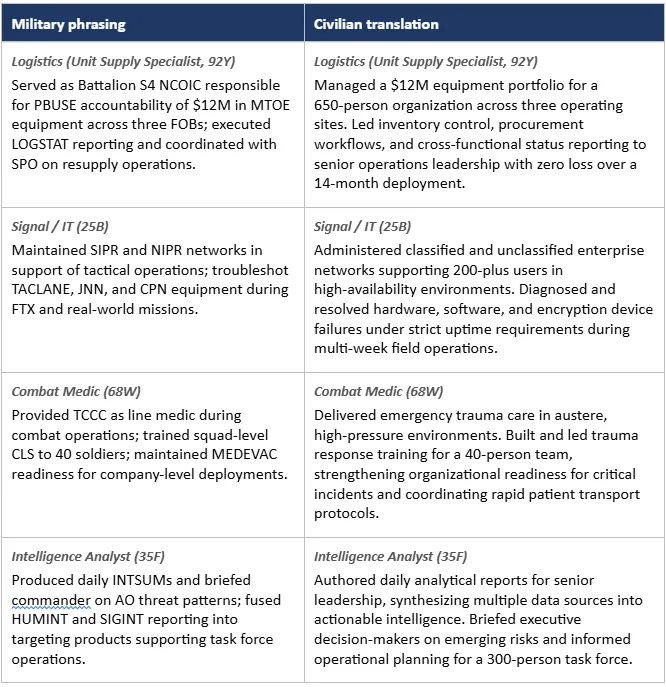
The pattern is consistent. Lead with the outcome. Name the scale in dollars, people, or sites. Use the civilian verb (managed, led, administered, delivered) instead of the military one (served, executed, maintained). Drop the acronym unless you have room to define it. Do that at every bullet and the resume starts to read like one a recruiter already knows how to place.
Tools That Do the Heavy Lifting
You don’t have to guess at translations. A few resources were built specifically for this:
- O*NET Military Crosswalk lets you enter your MOS, AFSC, or NEC and see matching civilian occupations with the skills and wages associated with each.
- CareerOneStop, run by the Department of Labor, offers a similar search tool plus local labor market data so you can see which roles are in demand where you want to live.
- LinkedIn’s Military Skills Translator, built with the Department of Defense, converts military job titles into civilian equivalents and suggests relevant job postings.
- TechVets publishes a detailed step-by-step guide for service members moving into tech careers, including how to map military experience to roles like cybersecurity analyst, cloud engineer, and IT project manager.
Use these as starting points, not final answers. The best translations are ones you’ve tailored to a specific job posting by mirroring the exact language in the description.
Positioning Your Hidden Advantages
Three parts of your military record are especially valuable in the civilian market, and they often get underplayed.
Leadership experience
Military service members take on formal leadership responsibility earlier than most civilians ever will. If you led a team at 22, say so plainly. Describe team size, what you were responsible for, and what results you drove.
The data backs this up. Findem’s market analysis found that veterans are 38% more likely than non-veterans to hold managerial roles, and 55% more likely to hold executive positions. That is not a coincidence. It reflects real leadership capability that civilian employers value once they can see it clearly on the page.
Technical certifications
Many MOS training programs include certifications that are directly recognized in civilian industries, including Security+, CCNA, EMT, commercial driver’s licenses, and aviation maintenance credentials. List them by name, not by the training pipeline that produced them.
Certifications show up in your paycheck. The ClearanceJobs 2025 Compensation Report found that cleared professionals with at least one professional certification earn an average of $125,371, compared to $110,919 for those without one. That is roughly a $14,500 annual premium for work you may have already completed in uniform.
Security clearances
An active Secret or Top Secret clearance can be worth tens of thousands of dollars in salary and opens doors in defense, aerospace, finance, and federal contracting. The ClearanceJobs 2025 Compensation Report pegs the average total compensation for cleared professionals at $119,131, up nearly 4% year over year. DoD Top Secret/SCI holders average $132,177, and Intelligence Community clearance holders (CIA, FBI, NSA) average $161,878. A current Lifestyle or Full Scope polygraph adds roughly $30,000 on top of that, with average compensation at $141,299.
Location matters too. Virginia, Maryland, and Washington, D.C. all report average cleared compensation above $127,000. If your clearance is current, put it near the top of your resume.
One caveat worth knowing. The same report shows that non-veterans in cleared roles out-earn veterans by roughly $8,000 on average ($121,950 versus $115,980). That gap closes for veterans who strategically leverage education, certifications, and high-paying locations. Even inside the cleared world, translation and positioning still matter.
What the Data Says
If you need evidence that employers benefit from hiring veterans, the numbers are compelling. The RecruitMilitary and Findem 2026 market analysis, which looked at civilian roles across engineering, sales, supply chain, and HR, found that veterans consistently bring more to the table than their non-veteran peers in comparable roles:
- Veterans bring 2 to 4 more years of qualified experience in the same role. For software engineers specifically, the gap is four full years.
- Veterans are 38% more likely to hold managerial roles and 55% more likely to hold executive positions.
- Veterans are 43% more likely to be top-performing salespeople.
- Veterans are 31% more likely to stay in a job for four or more years, which translates directly into lower turnover costs for employers.
- Veterans are 23% more likely to hold patents, pointing to practical, applied problem-solving.
- Veterans are 20% more likely to work in engineering roles without a bachelor’s degree, reflecting real learning agility.
And yet, despite those advantages, veterans are 6% to 13% less likely to be promoted than non-veterans in the same roles. That gap isn’t about ability. It is about recognition and framing. That is the whole argument of this piece in one statistic.
Separate research from Microsoft Military shows that military-trained candidates in technical roles ramp up faster, perform at high levels earlier, and contribute measurably to team outcomes compared to civilian peers with similar credentials. Organizations that invest in veteran hiring pipelines see strong returns on that investment.
This matters for two reasons. First, it gives you confidence that the value you bring is real and documented. Second, it gives you language to use in cover letters and interviews when an employer needs a reason to take a chance on a candidate whose background looks unfamiliar to them.
Actionable Takeaways
Before your next application, spend 30 minutes on these five steps:
- Pull the job description and highlight every skill, tool, and responsibility mentioned.
- Open your resume and find where you’ve done those same things in uniform. Rewrite each bullet using the civilian terms from the posting.
- Mirror the exact language in the job posting wherever it’s accurate to do so. Small word choices matter to both ATS software and human readers.
- Remove or define every acronym. If you have to keep one, spell it out the first time.
- Lead with outcomes. Start bullets with verbs like led, managed, built, reduced, or trained, and quantify whenever possible.
Closing
The skills you built in uniform are exactly the skills civilian employers are trying to hire. The work isn’t to change who you are. It’s to make sure the person reading your resume can see it.
Semper Forward exists to help you do that translation well, connect with employers who already understand the value you bring, and land in a role that respects the experience you earned. If you’re in the middle of transition or early in your civilian career, reach out. The next step is closer than it looks.
Sources
- RecruitMilitary and Findem, Unlocking the Potential of Veterans in the Civilian Workforce (2026).
- ClearanceJobs, The 2025 Security Clearance Compensation Report.
- Sierra Swanson, ATS Systems Explained: Why 75% of Resumes Get Rejected Before a Human Sees Them, DAVRON (October 2025).
- Microsoft Military, Military skills pay dividends in job performance.
- TechVets, How to transition from the military to a tech career: a step-by-step guide.
- U.S. Department of Labor, veteran unemployment data as of May 2025.
- O*NET OnLine, Military Crosswalk Search.
- CareerOneStop (U.S. Department of Labor), Veterans Job Finder.